Written by Kirsten Flores
On March 6, 2026, the United States and Israel launched Operation Epic Fury, a large-scale air campaign that has seen over 3,000 targets hit and the reported deaths of at least 1,332 people in Iran. At ground zero lies the killing of Supreme Leader Ali Khamenei, a figure who has ruled Iran for nearly thirty years. This “decapitation strike,” removing him, along with targeting the Iranian President and intelligence chiefs, is a familiar pattern that emerges: the pursuit of absolute hegemony and the relentless pursuit of profit at the cost of human lives.
This conflict is not localized, but a blatant war of economic strangulation, with violent ripples that extend right to the gut of the Philippines’ economic survival. As Tehran responds by closing the Strait of Hormuz, nearly a fifth of global oil supply is constrained at a critical chokepoint, driving oil prices up by as much as 30% within a week. For the Philippines, this is the cost of dependence on imported fuel and a superpower-led global oil regime: a market so volatile that every geopolitical tremor abroad becomes a crisis at the pump.
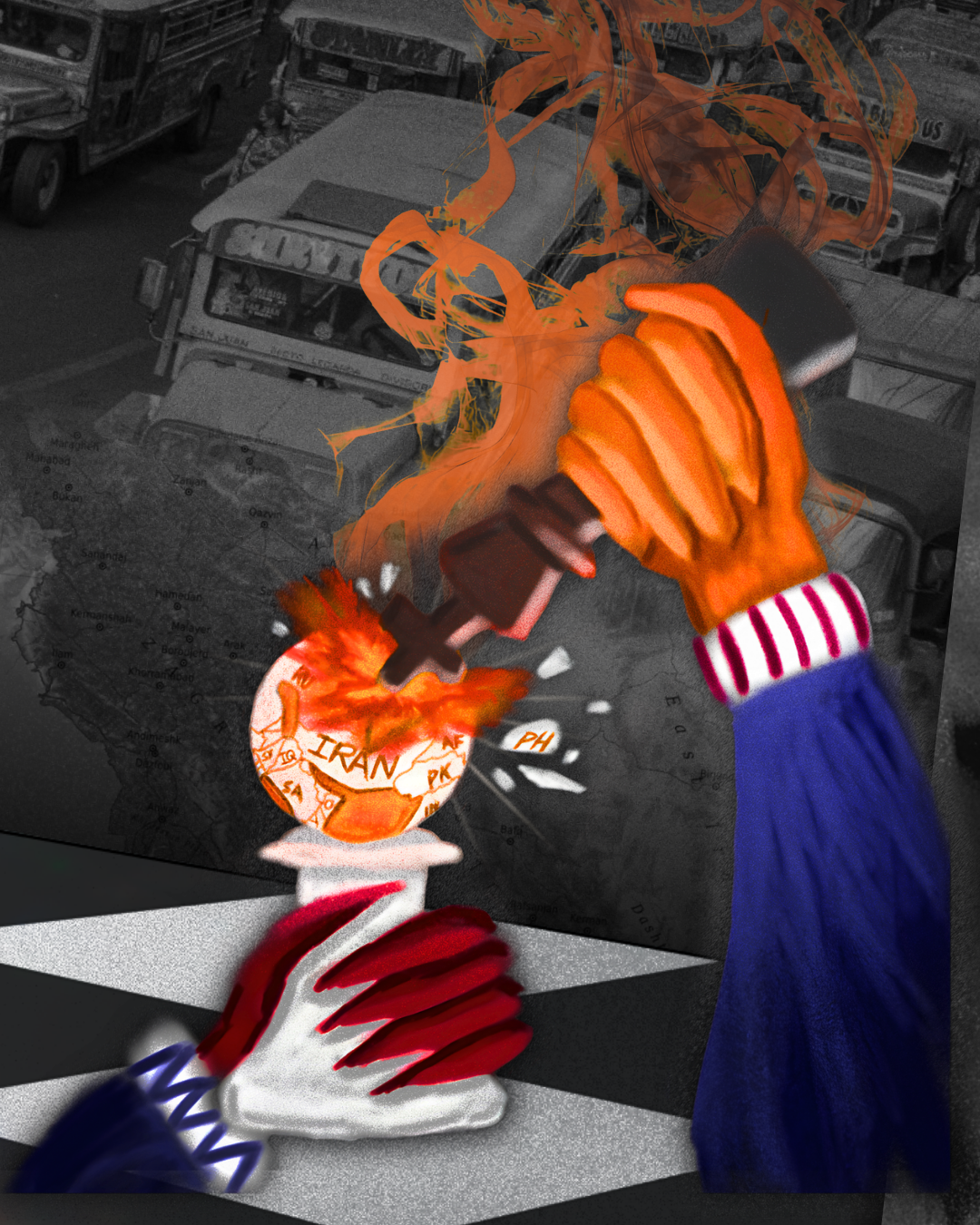
What does this mean for us, and most importantly, the working class? In a nation with limited fuel reserves and a structurally large import bill, we face the “fastest pass-through” of these global shocks to our local gas pumps. This is not a market fluctuation; it is a weaponized theft of livelihood. How much can our people sacrifice for a compromise to uphold our nation’s productivity? Php 56 for a day’s work is barely enough for a kilo of rice to feed the family of a jeepney driver, a grim reality that exposes the administration’s Php 5000 fuel subsidy as a band-aid solution that kills.
A pawn’s sacrifice
For our tsupers,this surge is a theft of their daily take-home pay, forcing them to choose between fuel and food. While the government has announced financial support for public transport drivers, more targeted solutions are needed to protect the truly vulnerable from a crude price that has already surged past $100 a barrel. Rather than holding on to the administration’s empty promises, many public utility vehicle (PUV) drivers have already decided to leave behind the livelihood they have upheld and fought for for so many years.
For commuters, the crisis manifests differently: higher fares and the ballooning cost of basic commodities as transport inflation ripples through the market. Can we even hold on until the 60-day mark of the country’s oil supplies? Or will the lack of proactive measures lead to our children being forced out of school, further strain already burdened workers, and aggravate our hunger?
We don’t need the Department of Energy’s (DOE) staggered oil price hikes. It does nothing to protect us from the deeper stakes of this conflict. We are not only vulnerable to the ambitions of the U.S. and its allies, but we also crumble at our dependence on imported energy. Nationalization policies for the energy and oil industry remain at the very core of the Philippines’ pressing needs. Decremental taxes such as VAT and excise tax, along with regressive legislation like the Oil Deregulation Law, continue to burden consumers and prioritize foreign corporate profit.
Without these radical shifts, we risk being swallowed by a vacuum of national survival. Just as the U.S. and Israel attempt to tear down Iran through inhumane strikes, they treat the Philippines as a mere strategic outpost. When the state allows our survival to be dictated by imperialism, sovereignty becomes a hollow concept; the true threat to our independence is the violence of manufactured hunger and the economic strangulation that empties the stomachs of our people.
Blundering the gambit
While the Armed Forces of the Philippines (AFP) assures us that the Philippines is “not under any threat” from Iranian missiles due to the 7,500-kilometer distance between our shores, such geographical insulation is an illusion. Our nation is deeply entwined with the fate of the Middle East through the millions